Do Not Fear


Background:

The October 16, 2011 devotional in Open Windows, (the 75th year of publication by Lifeway, an SBC entity) dealt with the topic of fear. It was timely for me and prompted me to share my thoughts on the verses through my blog.  Admittedly, I needed these verses today and I believe God pointed me to them through the devotional for just that reason.  Hopefully it will be meaningful to you as well.

Scripture:

Isaiah 41:10-13 (NIV)

10 So do not fear, for I am with you;  do not be dismayed, for I am your God. I will strengthen you and help you;  I will uphold you with my righteous right hand. 

11 “All who rage against you will surely be ashamed and disgraced;  those who oppose you will be as nothing and perish. 

12 Though you search for your enemies,  you will not find them.  Those who wage war against you will be as nothing at all. 

13 For I am the LORD your God who takes hold of your right hand and says to you, Do not fear;  I will help you.

In these verses God very specifically deals with His children’s (and my) unnecessary fears.  Whether those fears are real or imagined, God says He is with us … even in the darkest and toughest of times.  We should not be “dismayed” because He is in control and will “strengthen you and help you.”  It is through God’s righteous right hand, His power, His might, His righteousness, that we will be delivered through our trials.

Reflection:

Trusting in our own strength in perilous times is such a feeble approach to life when we have the All Powerful Jehovah God as our protector.  God tells us very emphatically do not fear and I, for one, intend to trust Him for that promise.  I like the wording for Proverbs 3:5-6 found in the Good News Translation (GNT) of the Bible.

5 Trust in the Lord with all your heart.  Never rely on what you think you know.

6 Remember the Lord in everything you do, and He will show you the right way.

Oh Lord, forgive me for letting myself fall prey to unnecessary fear.  I know that You are in control, you know my every need, and You will guide and protect my every step in accordance with Your plan and Your will for my life.  Amen.

Posted in Uncategorized | Tagged , , , , , , , | 10 Comments

What Is A Friend?


Background:

Webster defines “friend” as: one attached to another by affection or esteem; an acquaintance; one that is not hostile; one that is of the same nation, party, or group.

With the advent of modern social networking programs such as Facebook, the word “friend” has taken on another new meaning … one that actually distorts the traditionally accepted meaning of the word, particularly for our younger community.  A “Facebook Friend” is loosely defined as someone added to your social network.  A “Facebook Friend” may or may not be someone you have previously met.  They could be someone you simply allowed to join your network.  It has become a game for many to accumulate as many “friends” as possible on Facebook.  You will often hear of celebrities who have hundreds of thousands, even millions, of such “friends.”  Even teenagers often boast of thousands of friends.  But are they really “friends”?

How is it that someone can have so many “Facebook Friends” but few, if any, true friends?  The Bible provides a basis for understanding the nature of true friendship.  It is my purpose here to help you gain a greater appreciation for your friends and to ultimately become a better friend.

Discussion:

Friendship is something that is often taken for granted. But real friendship comes at a price.  Can you imagine for a moment what life would be like without friends? What would your life be like without your best friend?  What would you miss if you did not know your best friend? To many, life would be lonely without a friend.  At the same time, a false friend is a liability (take the Prodigal son, for example).  False friends will not help in times of trouble.  When God allowed Satan to test Job with problems and plagues, his friends deserted him. Job finally wished his three friends would go home and not add to his suffering. So, let’s discover together some of the answers to the question “What is a Friend?”

All scriptures listed herein are taken from the New International Version (NIV) unless otherwise noted.

1.  A friend knows you. … someone who knows all about you and loves you anyway … the one who steps in when the whole world steps out … someone who never gets in the way, except when we are on the way down.

  • Prov. 17:17 – A friend loves at all times, and a brother is born for a time of adversity.
  • Prov. 18:24 (NASB) – A man of too many friends comes to ruin, But there is a friend who sticks closer than a brother.

2.  A friend is someone who loves you.

  • John 15:13 – Greater love has no one than this: to lay down one’s life for one’s friends.
  • I John 3:16 – This is how we know what love is: Jesus Christ laid down his life for us. And we ought to lay down our lives for our brothers and sisters.
  • Colossians 3:12-14 (RSV) – Put on then, as God’s chosen ones, holy and beloved, compassionate hearts, kindness, humility, meekness, and patience, bearing with one another and, if one has a complaint against another, forgiving each other; as the Lord has forgiven you, so you also must forgive. And above all these put on love, which binds everything together in perfect harmony.
  • Prov. 17:17

3.  A friend has things in common with you.

  • 2 Kings 10:15 – After he left there, he came upon Jehonadab son of Rekab, who was on his way to meet him. Jehu greeted him and said, “Are you in accord with me, as I am with you?”  “I am,” Jehonadab answered. “If so,” said Jehu, “give me your hand.” So he did, and Jehu helped him up into the chariot.

4.  A friend protects you.  Consider Jonathan‘s unquestionable loyalty to his friend David as an example of how a friend will protect you.

  • 1 Sam. 19:1-7 – 1 Saul told his son Jonathan and all the attendants to kill David. But Jonathan had taken a great liking to David 2 and warned him, “My father Saul is looking for a chance to kill you. Be on your guard tomorrow morning; go into hiding and stay there. 3I will go out and stand with my father in the field where you are. I’ll speak to him about you and will tell you what I find out.” 4 Jonathan spoke well of David to Saul his father and said to him, “Let not the king do wrong to his servant David; he has not wronged you, and what he has done has benefited you greatly. 5He took his life in his hands when he killed the Philistine. The LORD won a great victory for all Israel, and you saw it and were glad. Why then would you do wrong to an innocent man like David by killing him for no reason?” 6Saul listened to Jonathan and took this oath: “As surely as the LORD lives, David will not be put to death.” 7 So Jonathan called David and told him the whole conversation. He brought him to Saul, and David was with Saul as before.
  • 1 Sam. 20:1-42 – http://www.biblegateway.com/passage/?search=1%20Sam.%2020:1-42&version=NIV
  • 1 Sam. 23:16-18  – http://www.biblegateway.com/passage/?search=1%20Sam.%2023:16-18&version=NIV

5.  A friend makes you happy.

  • Prov. 27:9 – Perfume and incense bring joy to the heart, and the pleasantness of a friend springs from their heartfelt advice.
  • 2 Tim. 1:16 – May the Lord show mercy to the household of Onesiphorus, because he often refreshed me and was not ashamed of my chains.
  • Phil. 1:3-5 – 3 I thank my God every time I remember you. 4 In all my prayers for all of you, I always pray with joy 5 because of your partnership in the gospel from the first day until now

6.  A friend helps when you are in trouble.

7.  A friend is loyal, unswerving in allegiance.

  • Prov. 17:17 – A friend loves at all times, and a brother is born for a time of adversity.
  • Prov. 27:10 – Do not forsake your friend or a friend of your family, and do not go to your relative’s house when disaster strikes you — better a neighbor nearby than a relative far away.

8.  A friend brings out the best in you.

  • Prov. 27:17 – As iron sharpens iron, so one person sharpens another.
  • Luke 17:2 – It would be better for them to be thrown into the sea with a millstone tied around their neck than to cause one of these little ones to stumble.
  • Acts 9:13-14, 26 (Barnabas) – 13 “Lord,” Ananias answered, “I have heard many reports about this man and all the harm he has done to your holy people in Jerusalem. 14 And he has come here with authority from the chief priests to arrest all who call on your name.”26 When he came to Jerusalem, he tried to join the disciples, but they were all afraid of him, not believing that he really was a disciple.
  • 2 Tim. 4:11 – Only Luke is with me. Get Mark and bring him with you, because he is helpful to me in my ministry.

9.  A friend is interested in your spiritual well-being.

  • Job 16:21 – on behalf of a man he pleads with God as one pleads for a friend.
  • Job 42:10 – After Job had prayed for his friends, the LORD restored his fortunes and gave him twice as much as he had before.
  • Deut. 13:6-8 – 6 If your very own brother, or your son or daughter, or the wife you love, or your closest friend secretly entices you, saying, “Let us go and worship other gods” (gods that neither you nor your ancestors have known, 7 gods of the peoples around you, whether near or far, from one end of the land to the other), 8 do not yield to them or listen to them. Show them no pity. Do not spare them or shield them.
  • John 5:1-9 – The healing at the pool near the Sheep Gate –  http://www.biblegateway.com/passage/?search=john%205:1-9&version=NIV
  • Luke 5:17-26 – Jesus Forgives and Heals a Paralyzed Man – http://www.biblegateway.com/passage/?search=Luke%205:17-26&version=NIV

Reflection:

Let’s do a little self-evaluation on friendship. Think of your friend as you ponder these questions:

  • What common interests do I have with my friend?
  • Would my friend be offended if he or she knew what I said behind his or her back last week?
  • Do I listen to my friend when he or she comes to me with a problem?
  • When was the last time I prayed for my friend’s needs?
  • Am I certain my friend is saved? Have I ever taken the time to present the plan of salvation to him or her?

The Bible teaches a friend loves at all times.  A friend is one who makes you feel good inside; is there when no one else cares; sees your good points when everyone else sees your failures; but most importantly spends time before God in prayer for you.  Remember, friendship is a two-way street.  The question is, “Am I that kind of friend in return?”

Posted in Uncategorized | Tagged , , , , , , | 2 Comments

On Not Being Fed


Background:

Have you ever overheard someone say something like this – “You know, I’m attending church regularly and listening intently to our Pastor’s sermons, but I’m just not being fed.” Most frequently this comment is made privately … party to party … and accompanied by a follow-up comment that they are thinking about looking for another church.  Is that really the answer?  What is the root cause for this supposed feeding problem?  Could it be a personal spiritual problem?

Discussion:

I can recall a number of instances over my lifetime where a rather mature Christian has shared with me their dissatisfaction with the leadership and/or direction of their local church.  In some cases, the comments have been cloaked in an excuse that they are not being spiritually fed.  In my observation, more often than not, their attitude toward their church had shifted from positive to negative.  The shift in attitude may have resulted from one specific incident or developed over a period of time.  Often, the party was unnecessarily spreading their negativism to others in the church to bolster their personal position thus hurting the overall health of their church body.  Sometimes the negativism was rooted in disagreement with what the Pastor was preaching, what the Deacons were either doing or not doing, or how someone in leadership had responded to a specific situation.  Sometimes the discontent resulted from a basic disagreement on doctrine and/or biblical interpretation.

I recognize that there are certainly some situations where the Pastor and/or church leadership may be at fault because they have strayed from true Biblical teachings.  However, regardless of the supposed cause, I have observed that in many cases the root of the problem likely originated internally in the heart and mind of the complainer rather than externally.

Let me get to some basics with an analogy.  When a baby is born he/she is almost helpless and totally dependent on others.  Among many other things, babies must be changed, bathed, dressed, carried, and fed by their parents.  Over time babies mature to new levels and they do more and more for themselves.  Ultimately, babies become children, and then teens, then adults and they are able and expected to provide for themselves.  They are now in a position to feed not only themselves but others.  They have become productive and self-sufficient. With regard to the church, it is indeed true that the church and its Pastor have a responsibility to feed (and equip) the flock.  But I contend that the mature Christian also has a significant responsibility to be feeding others and not so focused on being personally fed.   While not directly related to this topic, I can’t help but recall a scripture contained in one of the greatest Bible passages on Christ-like love which is contained in 1 Corinthians 13:11 (KJV) – “When I was a child, I spake as a child, I understood as a child, I thought as a child: but when I became a man, I put away childish things.”  I find it rather childish for the mature Christian to expect to be continually fed by someone else other than God Almighty.  God physically fed the Israelites for forty years as they traversed their path to the “promised land.”  And without question, He can certainly feed the spiritually hungry today.

So why is it that some church-going believers seem to expect their spiritual side to be sufficiently fed by their church?  Is it based on the false assumption that the purpose of the church is to provide members with their spiritual food?  Have they just become lazy or conditioned to being spoon-fed the word of God?  Have they relegated their Bible study to just attending Sunday services and listening to the preacher’s message instead of daily digging into His word for spiritual food?  Have they turned over the responsibility for their relationship to God to someone else?  Do they have a different agenda altogether than the leadership of their church?

I contend that spiritual growth and Christian vitality are ultimately the responsibility of individual believers … not the responsibility of the church and/or the Pastor.  Most assuredly, the church and the Pastor have a responsibility to encourage members and to provide Bible based programs, studies, Sunday school classes, materials and Pastoral messages that support the walk of church members.  Nevertheless, it is foolish to expect the individual Christian’s spiritual growth to result solely from the “feeding” of others.

Reflection:

Here’s some advice for those who may have fallen prey to the “not being fed” by my church syndrome.

  • First, inspect your attitude.  If it is negative, then give it over to God  for a positive one.  See Philippians 2:5-7 (NASB) – “Have this attitude  in yourselves which was also in Christ Jesus, who, although He existed in the  form of God, did not regard equality with God a thing to be grasped, but  emptied Himself, taking the form of a bond-servant, and being made in the  likeness of men.”
  • Put your selfish pride aside in favor of humility.  See Luke 18:9-14 for a parable of Jesus contrasting the temple visit of the Pharisee and the tax collector.  Click on this link for the scripture: http://www.biblegateway.com/passage/?search=Luke+18%3A9-14&version=NIV
  • Next, take over the full responsibility for your relationship to God.  Read your Bible faithfully and regularly … it is the “Ap” that you need to feed your spiritual void.
  • Develop a consistent devotional and prayer life … don’t just depend on others to do your praying for you.
  • Exercise your God-given spiritual gifts.  Others can’t use your spiritual gifts for  you.
  • Support your church leadership even when you don’t totally agree with them.  God has called  your leaders to their positions and given them His direction.  They need your support … not your criticism.  If your church leadership is teaching false doctrine or sinfully leading the congregation to do wrong, you can rest assured that God will hold them responsible for their actions and deal directly with them.
  • Faithfully, consistently, wholeheartedly and positively attend and participate in all of your church’s activities.
  • Change your focus from personally being fed to “feeding” others.  Feeding others is Biblical.  Think about the example of Jesus and the miraculous results of the feeding of the five thousand with the two fishes and five loaves (Matthew 14:13-21, Mark 6:31-44, Luke 9:10-17, John 6:5-15).  God will bless your feeding activities and magnify the results using His math.  You may be pleasantly surprised with the results as your ill feelings fade away and you are bathed in God’s love.
Posted in Uncategorized | Tagged , , , , , | 4 Comments

Believers as Givers versus Takers


Special Note: This article is included in Jim’s book “Christian Devotions & Quick Studies” along with 33 other articles and is available for purchase in Hardback, Paperback and eBook formats at this link:  Jim’s Books

Support independent publishing: Buy this book on Lulu.

Get Jim’s FREE eBooks Here!!

Background:

The primary purpose of this article is to point out some of the fundamental differences between givers and takers and hopefully persuade some believers to move from being a taker to a giver.  I hope you will find the information helpful. 

Discussion:

As recorded in the Bible in Genesis chapter 2, God created the first man, Adam, from the dust of the ground and breathed life into him.  That was good.  God provided the Garden of Eden to Adam and gave him dominion over all of His creation.  That was good.  There was only one exception required of Adam by God … Adam should refrain from eating of the fruit of the “tree of the knowledge of good and evil.”  God created and gave Eve as Adam’s wife and helpmate.  That was good.  Man’s fall into sin came about as a direct result of Eve’s (and Adam’s) disobedience in partaking of the fruit of the tree of knowledge.  In this case, God “gave” the garden … and that was good; man “took” of that which God forbade … and that was bad … disastrous for both Adam and Eve and the future of all mankind yet to come.  As Paul puts it in Romans 5:12 (KJV), Wherefore, as by one man sin entered into the world, and death by sin; and so death passed upon all men, for that all have sinned.”

God is the ultimate “giver”, the greatest “Giver” of all time.  He gave His son Jesus to the world to redeem mankind from the consequences of his sin.  John 3:16 (KJV) states that “For God so loved the world that He gave His only begotten son (Jesus), that whosoever believeth in Him should not perish, but have everlasting life.”  Accepting God’s free gift of salvation is not an act of “taking,” it is instead an act of “receiving” … receiving the gift freely given by Almighty Jehovah God.  God gave His most cherished possession, Jesus, to stand in for us and take upon Himself the sins of all who would receive Him as Savior.  Jesus paid the price for our sins.  No one else could do that.  What a giver! 

The Bible records a number of examples of givers and takers.  The list below provides just a few that came to mind.  Perhaps you can think of others.

Givers                                                                           Related Scriptures

God, Jesus                                                                   John 3:16; John 10:18

The Widow who gave the mite                               Mark 12:41-44; Luke 21:1-4

Paul on Phoebe                                                          Romans 16:1–2

Abraham & Isaac                                                       Genesis 22:1-19

Boaz                                                                             Ruth

Good Samaritan                                                         Luke 10:25-37

Onesiphorus                                                               2 Timothy 1:16-18; 2 Timothy 4:19

Stephen                                                                       Acts 6 and 7

Takers                                                                          Related Scriptures

Satan                                                                            John 10:10-11; 2 Cor. 10:3-5,

Judas – betrayal of Jesus                                          Luke 21:37-22:6

Cain – kills his brother Abel                                     Genesis 4

Rich Young Ruler                                                        Mark 10:17-22

Ananias & Sapphira – attempt to cheat church   Acts 5

Diotrephes – unjust criticism and accusation      3 John 1:9-11

Absalom – conspiracy to take David’s kingdom  2 Samuel 15

Ahab and Jezebel – evil to the core                       1 Kings 16-22

Givers and takers respond differently when presented with the same situation.  Thomas F. Fischer, editor of MinistryHealth.net provides an exhaustive list of the differences between givers and takers.  For example, when confronted with a need, Fischer says a taker would ask “Why should I help?”  Whereas, the giver would ask “Why shouldn’t I help?”  Fischer says givers seldom call attention to themselves, whereas takers are often braggarts.  He also relates that givers invest in others and takers invest in themselves.  You can find Fischer’s full listing of differences between givers and takers at this link:  http://www.ministryhealth.net/mh_articles/239_101_plus_differences_givers_vs_takes.html

God wants believers to follow His lead and conduct their lives as givers … not takers.  Genuine heart-felt giving is a direct reflection of God at work in the life of the believer.  Givers provide energy and faith that can strengthen and transform the church.  Takers consume and squash energy, often show a lack of faith and drive wedges into the unity of the church.  Givers provide enthusiasm, trust their leaders and are willing to sacrifice.  Takers exude pessimism, question their leaders and sacrifice little or nothing.  Givers generously contribute their tithes and offerings to their church.  Takers keep the vast majority of their resources to themselves.  So which are you … a giver … or a taker? 

Reflection:

In closing, I am reminded of Paul’s encouragement to those of the Colossian church recorded in Colossians 1:9-10 (NIV):  For this reason, since the day we heard about you, we have not stopped praying for you. We continually ask God to fill you with the knowledge of his will through all the wisdom and understanding that the Spirit gives, so that you may live a life worthy of the Lord and please him in every way: bearing fruit in every good work, growing in the knowledge of God.”

Posted in Uncategorized | Tagged , , , , , , , , | 1 Comment

On Biblical Giving to the Local Church


Special Note: This article is included in Jim’s book “Christian Devotions & Quick Studies” along with 33 other articles and is available for purchase in Hardback, Paperback and eBook formats at this link:  Jim’s Books

Background:

Several years ago I was perplexed by a study on giving patterns at the local church.   The study showed that approximately 20% of those who regularly attend church do not financially support the church at all … zero, nil, nada … and that another approximately 30% of the church membership give what amounts to less than 5% of total offerings averaging less than a $1 per family per week.  The next 30% of givers account for approximately 15% of total giving. The study thus concluded that 20% of the membership provides 80% of the financial giving.  This giving scenario coincides with the modern world giving pattern perfectly (what is known as the Pareto Principle, the law of the vital few, the principle of factor scarcity, and the “80-20 rule”) and I  will expound on that in another article later.

Why do so many fail to give generously to their church?  You won’t be shocked by my overly simplistic conclusion.  Basically, it can be wrapped up in one simple three-letter word … SIN.  By definition, man is sinful, self-willed and rebellious.  Unfortunately, it appears that worldly thinking and practice has so invaded the church that many have put aside God’s teaching in favor of serving themselves.  Yes, I know that many are without jobs and even many more are under-employed.  Many  are discouraged and many are down-trodden.  Nevertheless, God’s principles for giving have not changed.  They are timeless.

Even before the time of Moses, God required that all were to give back to Him, and that giving starts with the “tithe.”  In simplistic terms, in Old Testament times  the tithe was defined as 10% of all increase (income), including the harvest, the livestock, the land, and all payments received.  The tithe was to be given from the “first  fruits”, the best, not what was left over. Jesus spoke specifically in Matthew 23:23 to the practice of tithing when He said:  “Woe to you, teachers of the law and Pharisees, you hypocrites! You give a tenth of your spices—mint, dill and cumin. But you have neglected the more important matters of the law—justice, mercy and faithfulness. You should have practiced the latter, without neglecting the former. Some theologians and modern-day Christians argue that tithing is no longer required in New Testament times.  But Jesus himself confirmed the principle of generous giving through tithes and offerings is absolutely still in effect today for all Christians along with justice, mercy and faithfulness.  I realize that I have oversimplified the explanation for tithing, but more detailed information is unnecessary for the purpose of this article.

The Bible has much to say about the free will giving of tithes and offerings.  Consider the following principles and scriptures on giving:

Scripture:

1.    Everything belongs to God and He is Lord of all.

 James 1:17 (NKJV)

Every good gift and every perfect gift is from above, and comes down from the Father of lights, with whom there is no variation or shadow of turning.

Everything, yes everything, belongs to God.  He has entrusted us to be stewards of His resources.  They are not ours.  They are God’s.  It is that simple.  Everything that we have comes from God.  He provides every “gift” that we have.  He owns it all.  When we give back to Him as He commands, then we are showing that God is truly the Lord of our life.  Our giving is an expression of thankfulness for all He has given to us.

2.   We are blessed when we give.

Acts 20:35 (NIV)

… remembering the words the Lord Jesus himself said: ‘It is more blessed  to give than to receive.’

I don’t know how many people have told me about the blessings they have received as a result of their giving.  I can’t explain it in any other way other than to say that you can’t  out-give God.  The blessings will likely not come to you in a monetary form.  As a result of your giving you may experience exceeding joy, peace that passes understanding and unexplained satisfaction with the accomplishments of others.  Jesus himself said “It is more blessed to give than to receive.”

 3.   Give freely to God and you will receive freely from God.

Luke 6:38 (NIV)

Give, and it will be given to you. A good measure, pressed down, shaken together and running over, will be poured into your lap. For with the measure you use, it will be measured to you.

Proverbs 11:24  (NIV)

One man gives freely, yet gains even more; another withholds unduly, but  comes to poverty.

The Bible teaches hat God grants abundant resources to those who manage them in accordance with His principles.  Solomon understood these principles and under the leadership of God explained to his son Rehoboam that withholding of our gifts to God leads to poverty.  Give freely, receive freely!

4.   Pray and ask God what He would have you give and then give cheerfully.

2 Corinthians 9:7
(NIV)

Each man should give what he has decided in his heart to give, not reluctantly or under compulsion, for God loves a cheerful giver.

Clearly what you give is between you and God.  God does not expect us to give in a legalistic fashion or because someone or something is twisting our arm to do so.  Giving grudgingly is worse than not giving at all.  If your heart is right, then giving will be done cheerfully.

5.   It’s not “how much” you give, but “how” you give.

Mark 12:41-44 (NIV)

41 Jesus sat down opposite the place where the offerings were put and watched the crowd putting their money into the temple treasury. Many rich people threw in large amounts. 42 But a poor widow came and put in two very small copper coins, worth only a few cents. 43 Calling his disciples to him, Jesus said, “Truly I tell you, this poor widow has put more into the treasury than all the others. 44 They all gave out of their wealth; but she, out of her poverty, put in everything—all she had to live on.”

God does not look at the amount we are giving.  Unlike man, He is not impressed with large amounts per se.  He has a different perspective than we do.  He is looking at our heart.  We are not to give out of our abundance.  The amount is not what is important.  It is our attitude that counts.

6.   When we fail to give to God, we are robbers!

Malachi 3:8-10 (NIV)

8 “Will a mere mortal rob God? Yet you rob me. “But you ask, ‘How are we robbing you?’ “In tithes and offerings. 9 You are under a curse—your whole nation—because you are robbing me. 10 Bring the whole tithe into the storehouse, that there may be food in my house. Test me in this,” says the LORD Almighty, “and see if I will not throw open the floodgates of heaven and pour out so much blessing that there will not be room enough to store it.

Failing to give our tithes and offerings is a serious offense to God.  When we withhold our offerings or hold back a portion of our giving we are robbing God.  Some try to  justify their lack of monetary giving by substituting something else such as  volunteering their time or overseeing a needed function.   While these are worthy actions and certainly part of Godly stewardship, they do not replace our tithes and offerings.  The Bible teaches that our tithes and offerings are to be given through the  “storehouse” which in modern times is the local church.  Sadly, many Christians have ignored this Biblical teaching and miss out on the joy of giving to the Lord and His work.

Reflection:

Some continue to overspend their God provided resources as though everything belongs to them and not God.  Some justify their selfishness in not giving generously to their local church using humanly twisted reasoning and excuses such as “I don’t make enough to tithe;” “If I tithe I won’t be able to pay my bills;” “I don’t agree with the way that my church spends its funds;” or “Tithing is an Old Testament principle and the New Testament does not require it.”  Perhaps this is why the floodgates remain closed to God’s blessings for so many.

In this tough economy few churches have all of the resources needed to accomplish God’s work … particularly financial resources.  Giving has been shrinking.  To combat the financial decline almost every church has cut spending.  Some have had to abandon ministries and go into what is basically a survival mode.  Others have no choice but to abandon their ministry as they are no longer able to financially support it.  Some churches have stepped up their promotion for giving through special offerings, sermons on giving, and conducting giving/pledge campaigns.  Others have had to turn to other means to raise revenues such as renting unused facilities to other churches.  Sadly, most members are not moved to provide realistic and/or meaningful Biblical financial support to their local church.

The truth is that God expects no less of Christians than full support of His work through our free-will giving to our local church through tithes and offerings.  That is God’s plan.  Are you doing your part?  If not, then I encourage you to turn to the Lord, pray for forgiveness and consider what He would have you to do.  Your church needs your financial support.

Posted in Uncategorized | Tagged , , , , , , , , , , , , , , , , , | 5 Comments

On Christians Spreading Rumors and Gossip in the Church


Special Note: This article is included in Jim’s book “Christian Devotions & Quick Studies” along with 33 other articles and is available for purchase in Hardback, Paperback and eBook formats at this link:  Jim’s Books

Support independent publishing: Buy this book on Lulu.

Get Jim’s FREE eBooks Here!!

Background:

So why write on this subject? … BECAUSE … nothing hurts a church more than the spreading of false rumors and gossip. Being honest with ourselves, all Christians must admit that at one time or another we have spread rumors. It might be something that is done quietly without serious intent, among just a few “close” friends. What may start off as a somewhat innocent statement can fast become something else as folks down the line add a little spin and/or twist when passing it on the next person. Sometimes the spin and/or twist is intentional … meant to drive home a point, tear down a reputation, or simply put someone’s integrity into question. Let me be quite frank, spreading gossip and rumors are a major tool of the devil.

Long-time Christians have probably heard countless sermons over their lifetime on the dangers of spreading rumors and gossip. Have you become calloused and immune to the topic? Are you too smug to admit that you might be contributing to the problem by either passing along the rumor/gossip or not stopping it in its tracks. Or, are you just pious enough to believe that only others are guilty of this sin?

I’m not a preacher or church staff person. I’m simply a Christian business man, a regular member of my church with a lot of chronological years to my credit. So my thoughts about spreading rumors and gossip don’t come from an exhaustive Biblical study done in a seminary. However, the Bible is absolutely clear on the subject. God thought enough about the topic to include it as the Ninth Commandment. There is absolutely NO room for misinterpretation. Rumors and gossip are sinful and do tremendous damage to the ministry and work of the church.

Scriptures (all NIV unless otherwise noted):

Read these scriptures for yourself and then you decide if you are presently guilty of this sin and in need of repentance.

  • Exodus 20:16 – “Thou shalt not bear false witness against thy neighbor.” (KJV)
  • Leviticus 19:16 – “Do not go about spreading slander among your people. Do not do anything that endangers your neighbor’s life. I am the Lord.”
  • Proverbs 11:13 – “A gossip betrays a confidence, but a trustworthy man keeps a secret.”
  • Romans 1:29 – “They have become filled with every kind of wickedness, evil, greed and depravity. They are full of envy, murder, strife, deceit and malice. They are gossips.”
  • 1 Timothy 5:13 – “Besides, they get into the habit of being idle and going about from house to house. And not only do they become idlers, but also gossips and busybodies, saying things they ought not to.”
  • Matthew 7:1 – “Do not judge, or you too will be judged.”
  • Proverbs 18:8 – “The words of gossip are like choice morsels; they go down to a man’s inmost parts.”

The following scriptures provide sound advice on how to personally avoid being involved in passing along rumors and gossip and how to stop it in its tracks. The list is in no way exhaustive … just representative.

  • Proverbs 26:20 – “Without wood a fire goes out; without gossip a quarrel dies down.”
  • Deuteronomy 13:14 – “Then you must inquire, probe and investigate it thoroughly.”
  • Matthew 7:12 – “So in everything, do to others what you would have them do to you, for this sums up the Law and the Prophets.”
  • Ephesians 4:29 – “Do not let any unwholesome talk come out of your mouths, but only what is helpful for building others up according to their needs, that it may benefit those who listen.”
  • Proverbs 6:16-19 – “These six things doth the Lord hate: yea, seven are an abomination unto him: A proud look, a lying tongue, and hands that shed innocent blood, An heart that deviseth wicked imaginations, feet that be swift in running to mischief, A false witness that speaketh lies, and he that soweth discord among brethren.” (KJV)
  • I Thessalonians 5:21 – “Prove all things; hold fast that which is good.” (KJV)

Reflection:

Even the life of Jesus was subject to hurtful rumor and gossip. Matthew records the words of Jesus in Matthew 11:18-19 (KJV) as He recounts the nasty and sinful statements made about John the Baptist and the Lord Himself: “For John came neither eating nor drinking, and they say, He hath a devil. The Son of man came eating and drinking, and they say, Behold a man gluttonous, and a winebibber, a friend of publicans and sinners …”

Each of us needs to look deep into our lives and hearts. We need to ask, “Is it I, Lord?” “Am I a gossip? Am I spreading rumors and gossip because of jealousy, vengeance, vanity or self-justification. Am I quietly involved in this “secret” sin? Is my family, my friends, or my church suffering because I am passing along half-truths, rumors and gossip?

The Bible teaches us that spreading rumors and gossip is sinful. It is particularly harmful to the church. It is an unhealthy activity that can unnecessarily bring about unjustified harm to church leadership and the Lord’s mission for the church.

You can take immediate action to halt the “rumor mill” in your church by stopping the spread of gossip in its tracks. If you make this a standard practice in your everyday behavior, others will follow your leadership. Kindly tell those spreading rumors that nothing good can result from such and that you don’t make a practice of participating in the rumor mill. Insinuations, gossip and half-truths when repeated often enough somehow become believable … even to the person responsible for initiating the information.

As I close this article, I am reminded of Psalm 51:10 – “Create in me a clean heart, O God; and renew a right spirit within me.” This verse convicts me. I am committed to doing what is right in the sight of God. Does it convict you?

____________________________________________________________

Related  Articles by Jim Davenport on this subject:

See all of Jim’s Books.

Other Christian Articles by Jim Davenport:

Southern Gospel Music by The Good News:

  • Listen to The Good News includes over 2 hours of southern gospel music recorded by The Good News quartet; once you are there scroll down and click on the tune you want to hear. Share “the good news” from The Good News with your friends.
Posted in Uncategorized | Tagged , , , , , , | 14 Comments

The Servant Who Suffered For Us – An Easter Devotional


Revised & Reposted: April 4, 2014

Background:

If you had been a Jew in Jesus’ day, you  probably would have been disappointed to learn that He was the promised and  long-expected Messiah.  The idea of a suffering messiah never gained general acceptance in the Jewish nation.  For the most part, the Jews very much wanted a political messiah who could free the nation from Roman control and create a stable Jewish government in Judea.  Most expected the Messiah to be a prominent and handsome person from the line of David, perhaps from one of the leading aristocratic families.  They expected a popular leader who would rally everyone to his cause.  Jesus was a  disappointment to most Jews on virtually every count.  He came from a humble family.  He had no political or military aspirations.  He sought neither fame nor fortune and was of ordinary physical appearance.

Suffering-ServantThe Old Testament writer Isaiah foretold all of this in advance in his prophesy.  Isaiah also told how the Messiah would free us from the bonds of sin.  God promised that the Servant of the Lord would suffer for the sins of others and ultimately be triumphant.  Let’s look at what Isaiah 53 had to say about the suffering Servant.

The Servant’s Appearance – Isaiah 53:1-3 (All Scripture KJV unless otherwise noted) 

1Who hath believed our report? and to whom is the arm of the LORD revealed?  2For he shall grow up before him as a tender plant, and as a root out of a dry ground; he hath no form nor comeliness; and when we shall see him, there is no beauty that we should desire him.   3He is despised and rejected of men; a man of sorrows, and acquainted with grief, and we hid as it were our faces from him; he was despised, and we esteemed him not.

Jesus  Washing the Feet of the Disciples

Jesus Washing the Feet of the Disciples

Isaiah described the appearance of the coming Messiah in terms that were diametrically opposed to commonly held Jewish beliefs.  How could the Messiah be a suffering Servant?  Jews believed that the long-expected Messiah would be a handsome, strong and mighty king like David, not a tender plant that would easily die out in dry ground.  Jews believed that the Messiah would be one that would be heralded by man.  He would be triumphant over all of the Jews enemies, particularly Rome, and make Israel a powerful nation.  Instead, Isaiah described the Messiah as one who was “comely”, without unusual strength, one who would suffer, one that would be despised and rejected, a man of sorrows well acquainted with grief.  You see, it was what was on the inside of the Servant that would matter … not the outward appearance nor in accordance with man’s expectations.

The Servant’s Substitutionary Suffering (Isaiah 53:4-6)

4Surely he hath borne our griefs, and carried our sorrows; yet we did esteem him stricken, smitten of God, and afflicted.  5But he was wounded for our transgressions, he was bruised for our iniquities; the chastisement of our peace was upon him; and with his stripes we are healed.  6All we like sheep have gone astray; we have turned every one to his own way, and the LORD hath laid on him the iniquity of us all.

The people of Isaiah’s day viewed lepers and diseased people as outcasts who were unclean, guilty of sin, untouchable and clearly to be avoided.  The average Jew would have believed that one who suffers must be paying the price for his sin.  So, it was logical for the Jew to believe that the Servant who suffered would be guilty of sin.  Of course, nothing could be further from the truth.  Jesus lived a perfect and sinless life.  The fleshly man finds this hard to believe.  Jesus did not have to suffer the consequences of sin.  Yet Jesus unselfishly and willingly took upon Himself the sins of all mankind (“our sorrows”) and paid the price through the shedding of His blood and death on the cross of Calvary for all of man’s sins.

?????????????????????????????????It is because of the “stripes” the Suffering Servant bore that we can be eternally “healed” and protected from the consequences of our sin.  Isaiah clearly states that all have sinned (gone astray), turned away from God and depended on self (turned every one to his own way).  BUT, God “laid on him the iniquity (sin) of us all.”  Romans 3:23 and Romans 6:23 echo Isaiah by stating “For all have sinned and come short of the glory of God”  and “For the wages of sin is death; but the gift of God is eternal life through Jesus Christ our Lord.”

The Servant’s Silence (Isaiah 53:7-8)

7He was oppressed, and he was afflicted, yet he opened not his mouth; he is brought as a lamb to the slaughter, and as a sheep before her  hearers is dumb, so he openeth not his mouth. 8He was taken from prison and from judgment; and who shall declare his generation? For he was cut off out of the land of the living; for the transgression of my people was he stricken.

bound_lamb_3The Servant knew that His death most assuredly was ahead, yet “he opened not his mouth.”   Why would the Servant allow Himself to be led as the innocent lamb to slaughter without hesitation.  Hebrews 9:22 (NKJV) provides the answer:  “And according to the law almost all things are purified with blood, and without shedding of blood there is no remission.”  The Servant/Messiah would provide the perfect sacrifice required for the remission of sin.  Paul describes Jesus this way in 2 Corinthians 5:21: “For He made Him who knew no sin to be sin for us, that we might become the righteousness of God in Him.” 

New Testament writer Luke describes how Philip used Isaiah 53:7-8 to witness to the Ethiopian eunuch.  The eunuch was a man of great importance, a God fearer and a Gentile, from what was known at that time as the land of “Cush”.  Cush is the term used by those of Jesus’ day to refer to all of the land that lay below Egypt, basically what we know today as Africa.  The eunuch had traveled more than 1,000 miles, a journey of at least 50 days one way, to worship the God of Israel in Jerusalem.  After hearing Philip’s witness the eunuch believed that Jesus was indeed the Servant/Messiah that he had just been reading about in Isaiah.   The eunuch trusted in Jesus as his Savior and was even baptized as an affirmation of his salvation experience.  Later the eunuch most assuredly returned to his land spread the message of Jesus.  This was indeed the fulfillment of the third part of Jesus’ marching orders given in Acts 1:8 “But ye shall receive power, after that the Holy Ghost is come upon you: and ye shall be witnesses unto me both in Jerusalem, and in all Judaea, and in Samaria, and unto the uttermost part of the earth.”

The Servant’s Triumph (Isaiah 53:11-12)

11He shall see of the travail of his soul, and shall be satisfied; by his knowledge shall my righteous servant justify many; for he shall bear their iniquities.  12Therefore will I divide him a portion with the great, and he shall divide the spoil with the strong; because he hath poured out his soul unto death, and he was numbered with the transgressors; and he bare the sin of many, and made intercession for the transgressors.

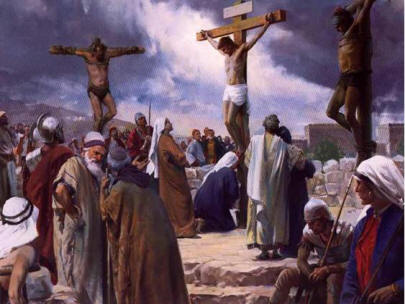
Suffering-Servant on the CrossThough the Servant suffered greatly taking upon Himself the sins of all mankind, He was greatly satisfied with the end result.  He had provided THE way for all men who confess their sins and accept Him as Savior to spend eternity with God in Heaven.  Jesus is that righteous suffering Servant that “made intercession for the transgressors.”  

Empty CrossThe Servant was triumphant over sin and death.  His suffering  provided the means for the salvation of ALL men.  The cross is empty because Jesus has conquered sin and death and is present in Heaven with God the Father.

In John 8:12 Jesus described Himself as the light of the world: “Then spake Jesus again unto them, saying, I am the light of the world; he that followeth me shall not walk in darkness, but shall have the light of life.”  Do you have that light of life?

Reflection: 

Things are not always what they appear to be.  Jesus demonstrated the relationship between suffering and salvation as He substituted himself as the sacrifice for our sins. His suffering was instrumental in providing our salvation. Consider the difference that His suffering and triumph have made in your life. Because of His victory over sin and death, those who commit their lives to Him by faith are justified. One day all the faithful will be exalted with Him!

Can you point to a specific time in your life when you asked Jesus to become your Savior?  If you answered yes, then rejoice in the difference He has made in your life!  If you answered no, then please click on this link (How to Become a Christian) to learn how to trust Jesus, the Servant who suffered for you,  for your eternal salvation.

Books by Jim Davenport: Please consider the purchase of Jim’s books to help spread the message of Christ Jesus.  Christian Devotions & Quick Studies is especially good to share with  a lost friend, someone needing encouragement or someone who does not have access to the internet.  My books are sold near the cost to produce as I am only interested in sharing the good news of the Gospel of Jesus to as many as I can before I go to Heaven.

See all of Jim’s Books.

Southern Gospel Music by The Good News:

  • Listen to The Good News includes over 2 hours of southern gospel music recorded by The Good News quartet; once you are there scroll down and click on the tune you want to hear. Share “the good news” from The Good News with your friends.
Posted in Bible Studies, Christian Devotions, Southern Gospel Music, Uncategorized | Tagged , , , , , , , , , , , , , , , , , , , , , , , , , , , , , , , , , , , | 3 Comments

On Pakistan’s Blasphemy Law


I have been sitting on this post for over two months.  In fact, every time I would try to write another article I couldn’t because all that kept coming to mind was this subject.  When I first thought of writing on this topic I was reluctant to do so.  I was so dismayed at the time about the cold-blooded murder by Islamic militants of Shahbaz Bhatti, Pakistan’s minister for minorities affairs, on March 3, 2011 on the streets of Islamabad, the capital.  Bhatti was the most senior Christian in Pakistan’s national government and the second Christian in the government to be murdered in Pakistan this year for speaking out against Pakistan’s blasphemy law which provides for the death penalty for insulting Islam.  The population of Pakistan is 97% Muslim.  The remaining 3% are made up of Christians and other non-Islamic religions.

I didn’t initially complete the article because I was worried about the negative impact my comments may have on some curiosity seekers who would read them.  You see, I don’t want to contribute to the mounting rift between Christians and Islam.  Rather, I am trying to educate my circle of friends on the dangers we face as Christians from the growing population  and radicalization of Islamic extremists.  The recent death of Osama bin Laden at the hands of the USA Navy Seals has sparked much world-wide publicity and controversy.  I may add my two cents in a future article, but that is not the purpose of this article.  Both positive and negative comments from well-meaning Christians about bin Laden’s death have convinced me that I must no longer hold back but speak out on the much lesser known death of Shahbaz Bhatti.

First, let me get a little personal.  Those that know me are well acquainted with the fact that I am a Christian in the final quarter of my earthly life.  Where I will spend my eternity has been settled with the one and only Almighty Jehovah God.  I have confessed that I am a sinner in need of a Savior, have asked God for forgiveness, and have accepted God’s only son, Jesus, as my Savior.  Jesus died on the cross of Calvary shedding his blood for me (and everyone else who will accept Him) to pay the price for the forgiveness of my (our) sins.  He rose from the dead on the third day conquering sin and death, was seen by many eye witnesses and 40 days later ascended back into heaven where He now dwells with His Father God.

There are so, so many in the world that are misguided and are seeking other ways to get to Heaven.  In particular and for purposes of this article, there are over 1.6 billion Muslims in the world that are trying to work their way to Heaven based on a method devised by man and clearly in conflict with God’s Word, the Bible (Acts 4:12: Roman 10:9-10).  You might want to refer to my article comparing some of the basics of Christianity versus Islam.  Here’s the link that will take you to that article: https://jimdavenport.wordpress.com/2011/02/18/christianity-versus-islam-2/

There is nothing I (or you) can do to work my (your) way to God’s eternity.  It is a free gift obtainable only by accepting Jesus as Lord and Savior.  If you, too, want to know how to become a Christian, you can follow this link:  https://jimdavenport.wordpress.com/2011/03/05/how-to-become-a-christian/

Up to this point in the article you might be saying to yourself, “Am I reading the wrong article?  I thought this was about Pakistan’s blasphemy law!”  I am getting to that but I first wanted to make sure that you knew I am not a paid journalist nor a radical Christian with an axe to grind against Muslims.  I don’t take credit for doing the research that describes the death of Bhatti.  I refer you to an article that appeared in the Wall Street Journal on March 3, 2011 by Zahid Hussain and Tom Wright for professional insight into the situation.  I strongly urge you to view the video that is available as part of the Wall Street Journal article as Mr. Bhatti predicts the method of his death four months in advance and vows to continue his cause for Christ regardless of what he expects to happen to him personally.  Oh that I would have such courage!!

https://jimdavenport.wordpress.com/2011/05/12/minister-is-gunned-down-in-pakistan/

Before turning to the blasphemy law in Pakistan, let me again state that I am simply an everyday Christian concerned about the lost, concerned about the abject lack of understanding of the modern-day radical Islamic threat to Christianity and world order, and in particular concerned about the direction and future of our nation and the American way of life.  I fully recognize that a relatively small percentage of Muslims are radicalized.  But this small percentage continues to wreak havoc on the world.  There are also a small percentage of Christians that have extreme views.  However, those extreme Christians do not generally resort to murder and violence to further their perverted cause.

Below you will find two sections of the Pakistan Blasphemy Law that are of particular concern to Christians.  Section 295-B states the penalty for defiling, damaging or desecrating the Quran – life imprisonment.  Section 295-C states the penalty for using derogatory remarks toward Mohammed – death or life imprisonment, and fine.  Read them for yourself.

295-B Defiling, etc., of copy of Holy Quran. Whoever willfully defiles, damages or desecrates a copy of the Holy Quran or of an extract  therefrom or uses it in any derogatory manner or for any unlawful purpose shall be punishable for imprisonment for life.
295-C Use of derogatory remarks, etc.; in respect of the Holy Prophet.   Whoever by words, either spoken or written or by visible representation, or  by any imputation, innuendo, or insinuation, directly or indirectly, defiles  the sacred name of the Holy Prophet Mohammed (PBUH) shall be punished with death, or imprisonment for life, and shall also be liable to fine.

Do you wonder why the Muslim population in Afghanistan, Pakistan and Iran had such a violent reaction to the burning of the Quran by Rev. Terry Jones of the Dove World Outreach Center?  To me, that was a cowardly act performed by a perverted and mis-guided so-called Christian.  Under Pakistan’s blasphemy law, Jones would most assuredly be condemned to death.  Radical Muslims are predisposed to react violently when such acts take place.  Many are taught as children to take such matters into their own hands.

On the flip side, I don’t know of any modern-day law elsewhere in the world that calls for the death of a person for defiling, damaging or desecrating the Bible.  In fact, the first amendment to the United States Constitution guarantees the right to burn the Bible, Quran or any other religious book.  While it might not be advisable, smart and certainly not in keeping with the teachings of the Bible, it is perfectly legal to burn the Bible and Quran in the USA.  The text of the first amendment reads “Congress shall make no law respecting an establishment of religion, or prohibiting the free exercise thereof; or abridging the freedom of speech, or of the press; or the right of the people peaceably to assemble, and to petition the Government for a redress of grievances.”

Pakistan’s laws are diametrically opposed to those of the USA when it comes to the freedom of religion.  Freedom of religion is a joke in Pakistan.  Shahbaz Bhatti put his life on the line for trying to soften the Pakistan blasphemy law.  As a result, he was killed … just as he expected … not by the government of Pakistan, but by those who want to see Islam as the only world religion and state supported theocracy.   To date the government of Pakistan has taken no action to identify and bring to justice the murderers of Mr. Bhatti.  With their blasphemy law still in place, are you surprised?  Could it be possible that those in the Pakistan government believe that the murder of Mr. Bhatti was justified by Pakistani law?  I wonder?

There are so many questions that still swirl in my mind as a result of this writing.  I suppose I could write a lengthy book and not adequately cover them all.  And needless to say, it would most certainly not be a scholarly work.  What I do know is that God is righteous and that judgment will fall upon those who are not made righteous through the blood of Jesus.  Let those of us who are Christians keep working to spread the message of Jesus to a world full of rejection and full of wrong answers.  We are God’s soldiers and God’s Word, the Bible, is our sword.  The ultimate judgment of evil is in God’s hands and the ultimate victor has already been revealed in the Bible.  I am glad to know that I am on the winning side.  I close with an appropriate verse from the hymn “Who Is On The Lord’s Side?”

“Fierce may be the conflict, strong may be the foe,
But the King’s own army none can overthrow;
’Round His standard ranging, victory is secure,
For His truth unchanging makes the triumph sure.
Joyfully enlisting, by Thy grace divine,
We are on the Lord’s side—Savior, we are Thine!”

Posted in Uncategorized | Tagged , , , | 1 Comment

Minister Is Gunned Down in Pakistan


Wall Street Journal

ASIA NEWS

MARCH 3, 2011

Minister Is Gunned Down in Pakistan

Killing of Christian Is Second of a Blasphemy-Law Critic; Puts in Question Effectiveness of U.S. Support for Moderates

By ZAHID HUSSAIN And TOM WRIGHT

ISLAMABAD—Suspected Islamic militants shot dead the most senior Christian in Pakistan’s national government, in the latest sign that political moderates backed by the U.S. are failing to rein in a growing wave of Islamist extremism.

The second killing this year of a politician who has stood against the blasphemy law, which sanctions the death penalty for insulting Islam, threatened to further destabilize a country where secular-minded politicians are increasingly imperiled by a rising strain of middle-class Islamism.

The chilling climate was highlighted in a video made by the latest victim, Shahbaz Bhatti, the minister for minorities affairs, to be released in the event of his death.

Associated Press

Members of Pakistan’s Christian community rally to condemn the killing of Shahbaz Bhatti in Lahore Wednesday.

The U.S. has attempted to bolster moderate elements of Pakistan’s society and combat religious extremism with huge disbursements of civilian aid, but the targeting of politicians who espouse secular views and are viewed as supporting the U.S. complicates this strategy. Ties between the two countries have hit new lows after a U.S. Central Intelligence Agency contractor in January was detained after shooting dead two armed men in Lahore.

The government of President Asif Ali Zardari, a U.S. ally, recently dropped moves to reform the blasphemy law, fearing a backlash from extremists.

Mr. Bhatti was traveling in Islamabad, the capital, to attend a cabinet meeting when three gunmen opened fire on his car, police said. The assailants dragged Mr. Bhatti from the vehicle before shooting more bullets into him. He died on the spot after receiving at least eight bullet wounds.

The killers, who escaped, dropped leaflets saying they had acted in the name of the Punjabi Taliban and al Qaeda because the government had put an “infidel Christian” in an important position.

“Bhatti’s murder is the bitter fruit of appeasement of extremist and militant groups,” said Human Rights Watch, the New York-based rights advocacy group, in a statement.

Mr. Bhatti, a 42-year-old Catholic, was a prominent campaigner for the reform of the country’s blasphemy law, which rights groups say has been used to persecute Christians and other minorities.

Salmaan Taseer, a former governor of Punjab province who also opposed the law, was gunned down in Islamabad by his police bodyguard in January. The guard, who said he was angered by Mr. Taseer’s stance, has become a national hero for Islamist groups and other conservatives.

Associated Press

Mr. Bhatti’s damaged car outside an Islamabad hospital

The blasphemy law, which was tightened by U.S.-backed military ruler Gen. Zia-ul-Haq in the 1980s, has come to symbolize the battle in Pakistan between religious and moderate forces that dates to the nation’s founding in 1947. Efforts to reform the law by a series of secular-leaning governments have foundered in recent years due to opposition from powerful Islamists, who draw support from the country’s middle classes, including lawyers and traders.

U.S. Secretary of State Hillary Clinton told the Senate Foreign Relations Committee she was “shocked and outraged” by the assassination. She called Mr. Bhatti, whom she met last month in Washington, a “courageous man” who was aware of the threats against him.

Ms. Clinton spoke of the values of tolerance for all faiths championed by Muhammad Ali Jinnah, the founder of Pakistan. But Mr. Jinnah died soon after the country’s birth and his inclusive vision gave way to a constitution in 1956 that made Pakistan an Islamic republic.

Mr. Zardari’s party, the moderate Pakistan Peoples Party, bills itself as Pakistan’s most liberal party and typically draws support from less religious-minded citizens, many in southern Sindh province. But the assassination of its leader, Benazir Bhutto, a two-time former prime minister and wife of Mr. Zardari, in 2007 by suspected Taliban militants has cowed party members.

Pakistan’s Religious Minorities Minister Shahbaz Bhatti, who was shot and killed by gunmen on Wednesday, comments before his death on threats he had been receiving. Video courtesy of First Step Forum.

Follow this link to a video made 4 months before his death as Minister Bhatti that predicts his assassination.

http://www.guardian.co.uk/world/video/2011/mar/02/pakistani-minister-shahbaz-bhatti-video

Mr. Zardari condemned Wednesday the killing of Mr. Bhatti and ordered an official inquiry but did not mention the blasphemy law.

U.S. ties to Mr. Zardari’s government have been strained by Pakistan’s failure to combat religious extremism, including the continued use of Pakistani soil as a haven for the Afghan Taliban that fight U.S. troops over the border.

U.S. officials have declined to detail the role of the CIA contractor detained in the January Lahore shootings, Raymond Davis, saying only that he provided security to CIA operatives. Pakistani officials believe he was part of a team gathering information on militant groups. U.S. officials said Mr. Davis, a former U.S. Special Forces soldier, shot in self-defense as the men tried to rob him. The U.S. says Mr. Davis is covered by diplomatic immunity.

But Mr. Zardari’s government, facing pressure from Islamist groups, has refused to order his release, pushing some members of the U.S. Congress to question the large amounts of U.S. aid for Pakistan. Mr. Davis’s trial in the Lahore jail where he is being held resumes Thursday.

Mr. Bhatti, who faced assassination attempts six years ago for his support of rape victims, recorded a video in December in Dubai with First Step Forum, a Finland-based Christian human-rights group, which made it public Wednesday. In the video, Mr. Bhatti says repeated death threats from militants wouldn’t deter him from supporting Christians and other minorities.

“I will die to defend their rights,” Mr. Bhatti says.

Targeted killings of politicians have created a newfound feeling of insecurity in Islamabad, a city that had been successful in stopping large-scale terrorist attacks for more than a year.

Taliban militants had in the past carried out a number of attacks in the city, most famously the truck bomb strike on the Marriott hotel in 2008. The government responded by putting a security cordon around the city, with checkpoints on major roads, and intensifying its war against Taliban militants on the border with Afghanistan.

The last major strike in Islamabad was a suicide bombing on the offices of the United Nations’ World Food Program in October 2009.

Militants have responded by moving to more-limited attacks, like Wednesday’s shooting, which are harder to guard against.

The killing of Mr. Taseer, Punjab’s former governor, by a police officer who was meant to protect him also has shown how difficult it is to rely on Pakistan’s security forces to guard against attacks due to widespread sympathies with militants.

Those strains date back to the 1980s when Mr. Zia-ul-Haq, whose government organized the Mujahideen to fight Soviet troops in Afghanistan with U.S. and Saudi funding, promoted religious orthodoxy among security personnel.

Fearing for his life, Mr. Bhatti had asked authorities for a bullet-proof car in recent months but hadn’t received one, said Johan Candelin, executive director of First Step Forum, the group which made the video of Mr. Bhatti. Wajid Durrani, Islamabad’s police chief, said Mr. Bhatti was provided protection in view of the threat to his life but was traveling without his security detail at the time of the attack.

Mr. Bhatti had angered Islamic extremists by urging changes in the blasphemy law. He was head of a parliamentary committee that was examining misuse of the law.

Authorities have yet to carry out a death sentence for blasphemy, with courts often commuting sentences. But human-rights groups say the law has encouraged militant violence against minorities. Scores of people—most of them Christians and Ahmadi Muslims—have been killed in attacks or are in detention facing trial under the law.

In many cases, people have used it to settle local scores unrelated to religion, these groups say.

Last year, a court sentenced a Pakistani Christian farm worker to death for blasphemy. The Vatican and rights groups have slammed the verdict and called for her release.

The death of Mr. Bhatti shook Pakistan’s small Christian community. Christians are the largest religious minority in the country, where about 5% of the 180 million population are non-Muslims. “We have lost our most courageous spokesman,” said Akram Massig Gil, a Christian member of parliament.

Mr. Bhatti’s killing also is likely to deepen security concerns for others who have spoken out against the blasphemy law. Sherry Rehman, a former minister of information and prominent opponent of the law, has beefed up her security after receiving threats.

—Rehmat Mehsud
contributed to this article.

Posted in Uncategorized | 1 Comment

On Harboring a Grudge


Background:

A number of years ago I allowed something that at the time was really hurtful to bother me terribly.  It was really against my nature to let anything get to me that deeply, but the fact is that it did.  My poor and resentful attitude was affecting not only me and my family, but my friends and my church family as well.  You see, the hurt had turned into a grudge and I didn’t even realize it.  It wasn’t that I wanted to get even with the hurtful party … it was more like I didn’t want to have anything to do with them and I was somehow getting even by withdrawing from them.  Perhaps you have experienced something like this yourself or you know someone who is going through such a situation right now.  If so, then read on and if you think it worthwhile, then pass this link on to someone else.

Discussion:

First, for purpose of my discussion let’s define what I mean by a “harboring a grudge”.  Webster defines a grudge as “a strong, continued feeling of hostility or ill will against someone over a real or fancied grievance.”   A grudge results from the leftovers of an unforgiving heart.  Harboring a grudge is a sign of a lack of love resulting in the sinful distortion of one’s character.  A grudge can grow from an open confrontation or a quiet and/or private disagreement.  Often times the one holding the grudge is the last one to realize they are doing so and oblivious to the fact that they are committing a sin.

At its worst, harboring a grudge can lead to bitterness, gossip, estrangement, slander and even hatred.  At its best, harboring a grudge can lead to a lack of commitment, subversion of cooperation, undue negative influence on others … especially those who are weaker in the faith.

Scriptures (all KJV unless otherwise noted):

Here are a number of scriptures related to my discussion and reflection points:

  • Ephesians 4:32 – “And be ye kind one to another, tenderhearted, forgiving one another, even as God for Christ’s sake hath forgiven you.”
  • Colossians 3:13 – “Forbearing one another, and forgiving one another, if any man have a quarrel against any: even as Christ forgave you, so also do ye.”
  • 1 John 4:20-21 – “If a man say, I love God, and hateth his brother, he is a liar: for he that loveth not his brother whom he hath seen, how can he love God whom he hath not seen? And this commandment have we from him, That he who loveth God love his brother also.”
  • 1 Corinthians 13:5 – Love “Doth not behave itself unseemly, seeketh not her own, is not easily provoked, thinketh no evil.”
  • Proverbs 10:18 – “He that hideth hatred with lying lips, and he that uttereth a slander, is a fool.”
  • 1 Corinthians 8:11 –“And through thy knowledge shall the weak brother perish, for whom Christ died?”
  • Proverbs 6:16,19 – “These six things doth the LORD hate: yea, seven are an abomination unto him: …  false witness that speaketh lies, and he that soweth discord among brethren.”
  • Other related scriptures: Proverbs 16:28; Proverbs 17:9; Luke 15:25-30; Romans.12:19; 1 Peter.2:23; 2 Corinthians 2:7

Reflection:

Each of us needs to look deep into our lives and hearts. We need to ask, “Is it I, Lord?”  Look about you, does the sight of someone bring hostile feelings to the surface.  Do you avoid someone just to keep from having to speak or wave?  Are you quietly, but politely, not supporting something or someone because you may be secretly harboring a grudge?  Is your family, your friends, or your church suffering because you are harboring a grudge?

Just as I had to do (and more than once I must admit), will you rid yourself of that grudge you are harboring while there is still time?  The Bible teaches us that harboring a grudge is sinful and unhealthy.  Recall these powerful scriptural examples as you seek forgiveness for harboring a grudge and God’s renewed guidance in your life:

  • Joseph did not harbor a grudge nor retaliate against his jealous brothers for selling him into slavery.  Instead, Joseph resettled his entire family in Goshen during an extreme famine in Canaan with the full favor of the Egyptian Pharaoh. (See Genesis 37-50). 
  • Jesus did not harbor a grudge against those who crucified Him, nor does he harbor a grudge against you.  Instead, He paid the price for all of your sins on the cross of Calvary.  (Romans 5:8 – “But God commendeth his love toward us, in that, while we were yet sinners, Christ died for us.”)  Jesus conquered sin and death through His resurrection from the dead and has made it possible for those who receive Him as Savior to spend eternity with Him in His heaven.  (John 1:12 – “But as many as received him, to them gave He power to become the sons of God, even to them that believe on his name.”)

As I close this article, I am reminded of the second verse of Fannie Crosby’s powerful hymn:

I Am Thine, O Lord

Consecrate me now to Thy service, Lord, By the power of grace divine. Let my soul look up with a steadfast hope, And my will be lost in Thine.

If we are truly to fulfill His will for our lives, then we must seek His forgiveness and healing and rid ourselves of any grudge, whether secret or open.

Posted in Uncategorized | Tagged , , | 3 Comments